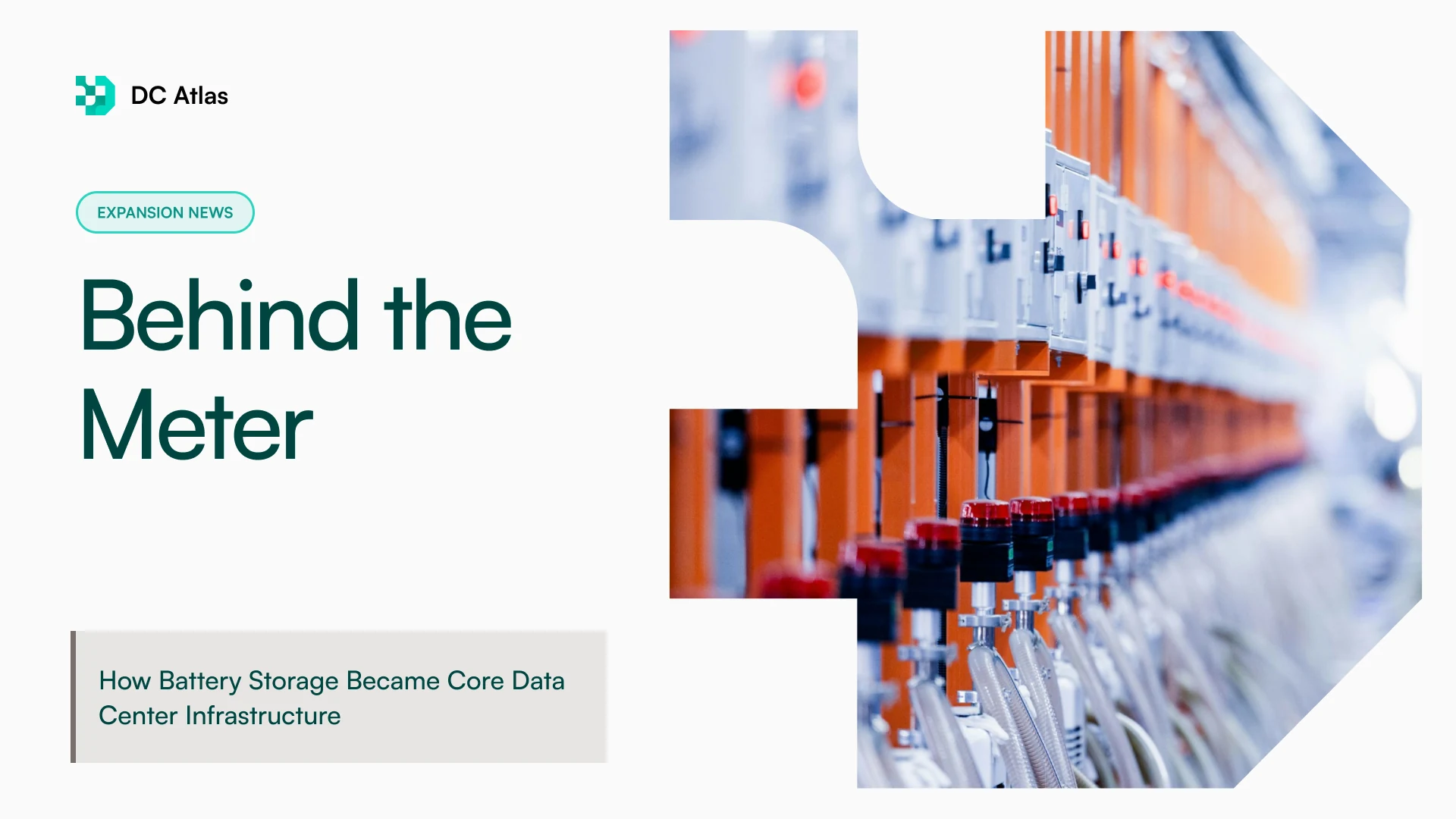
Behind the Meter: How Battery Storage Became Core Data Center Infrastructure
AI's spiky power draw broke the old assumptions about UPS systems and grid reliability. Here's how battery storage went from backup plan to primary strategy, and who's actually building it.

For a long time, the battery conversation in data centers was pretty simple. You had your UPS, your flywheel, maybe a lead acid cabinet in the corner of the power room. The generator handled outages. The UPS bridged the gap between grid failure and generator startup, a window measured in milliseconds, maybe a few seconds. That was the job. Nobody called it strategy.
Then AI happened, and the whole frame broke.
The problem isn't power outages. Modern grids in the United States are actually quite reliable at the transmission level. The problem is what's happening at the interconnection queue, at the utility substation, and inside the facility itself when a GPU cluster decides to pull 50 megawatts in a heartbeat and then throttle back without warning. Legacy UPS thinking was designed around a binary event: grid on, grid off. AI workloads are introducing something far messier, power demand that oscillates violently and continuously, at a scale that puts mechanical stress on transformers, creates voltage instability, and makes utilities deeply uncomfortable about what they're signing up for when they approve a new interconnection request. The old answer was "put in more capacity." The new answer, for operators who are actually thinking about this, is storage.
What AI Actually Does to Your Power Curve
It helps to be precise about what "spiky" means here, because the word gets thrown around loosely. A traditional compute workload, think web serving, database queries, enterprise software, runs at a relatively predictable utilization rate. It spikes during business hours, drops at night, with modest variance. Power draw follows a similar pattern. Utilities can model it, plan for it, sign capacity agreements around it.
A large language model training run operates on a completely different logic. When training is active, the GPUs are running at or near full utilization continuously, pulling maximum power for days or weeks at a time. Then the run ends, the cluster is reconfigured, checkpoints are loaded, and power demand drops sharply before climbing again. Inference workloads create a different pattern: highly variable demand tied to user request volume, with rapid ramps when traffic spikes. A viral moment, a product launch, a market event, these can spike inference demand dramatically within minutes.
Now multiply that across a 100 megawatt facility with thousands of H100s or Blackwell chips, and you have a situation where the facility might swing between 40 and 95 megawatts of draw within a timeframe that is genuinely challenging for grid infrastructure to handle gracefully. Utilities have to provision for the peak. Transformers have to be rated for the peak. Interconnection agreements have to cover the peak. And operators are paying demand charges based on their peak, regardless of how rarely they actually hit it. Storage changes the economics of every single one of those problems. Global data center electricity consumption is forecast to reach 1,050 TWh in 2026 Brookings Institution, a figure that makes the grid negotiation problem structural rather than situational.
“We're not just smoothing power anymore. We're using storage to negotiate with the grid on fundamentally better terms.”
The Interconnection Queue Problem Is Worse Than You Think
If you're not tracking the interconnection queue situation in the United States, here's the short version: it's bad, it's getting worse, and it's becoming one of the primary constraints on data center development in high demand markets.
Lawrence Berkeley National Laboratory has documented interconnection queue backlogs stretching five to seven years in major markets. Lawrence Berkeley National Laboratory In PJM territory, which covers a significant portion of the US data center footprint including Northern Virginia, new interconnection requests face multi year studies, cost allocations that can run into tens of millions of dollars, and outcomes that are genuinely uncertain. A 100 megawatt request submitted today might not clear the queue until 2030.
This is where behind the meter storage stops being an efficiency play and becomes a market access strategy. Here's the logic: if an operator can demonstrate to the utility that their actual peak draw from the grid is substantially lower than their installed IT capacity, because storage is handling the transient spikes and time shifting some demand, they can potentially secure a smaller interconnection agreement more quickly and at lower cost. A 200 megawatt facility that can credibly demonstrate a 150 megawatt peak grid draw, with storage handling the 50 megawatt delta during demand spikes, is a materially different interconnection request than a straight 200 megawatt ask.
This is not theoretical. Operators in constrained markets are actively structuring their power architecture with exactly this logic in mind, sizing storage systems not just for backup duration but for interconnection negotiation. It's a sophisticated play, and it requires getting the storage sizing right, which is considerably more complex than specifying a traditional UPS system.
From UPS to Energy Asset: The Hardware Evolution
The traditional data center UPS is an elegantly simple machine with a narrow job description. It takes utility power, converts it, stores a modest amount of energy in batteries (lead acid for decades, increasingly lithium iron phosphate today), and stands ready to deliver that energy for the seconds required to start a generator. Runtime was measured in minutes at best. The battery bank was sized for bridge time, not energy management.
What we're watching now is a fundamental rethinking of what that power infrastructure layer actually does. The new generation of systems being deployed in serious AI data center builds are doing several things simultaneously that the old UPS simply wasn't designed for.
First, they're doing active power smoothing. Rather than sitting idle until a grid event, modern battery systems are continuously managing the power factor and demand signature seen by the utility. When GPU clusters ramp hard, the batteries respond within seconds, contributing energy to meet the spike before the grid can react. Schneider Electric When workloads throttle, excess generation charges the batteries. The grid sees a much smoother load profile than the IT equipment is actually presenting.
Second, they're doing energy arbitrage. In markets with time of use pricing or real time energy markets, sophisticated operators are charging batteries during off peak low cost hours and drawing them down during peak pricing periods. At megawatt scale, the savings are material. Peak to off peak price differentials in competitive markets can exceed 3x during summer months U.S. Energy Information Administration, and a 10 megawatt hour storage system doing daily arbitrage cycles accumulates meaningful cost reduction over a year.
Third, they're participating in grid services markets. Frequency regulation, demand response, spinning reserves: grid operators pay real money for assets that can respond quickly to grid stability needs. U.S. grid-scale battery storage additions reached 9.7 GWh in Q1 2024 alone, up 32% year over year seia.org, a signal of how seriously the broader market is taking storage as grid infrastructure. A large battery system behind a data center meter is technically capable of participating in these programs, though the operational complexity of doing so while guaranteeing data center reliability is nontrivial. The most aggressive operators are working through this complexity because the revenue streams are real.
U.S. Battery Storage Market: Segment Mix vs. Outlook
Share of installed U.S. storage capacity by segment, 2024 actual vs. 2030 projected
Source: SEIA / Benchmark Mineral Intelligence via E&E News (2024). Behind-the-meter 2030 figure is a projected share.
Panasonic's Bet and What It Signals
Panasonic's move toward AI data center batteries is worth examining in some detail because it represents a meaningful signal about where serious industrial capital is flowing. Panasonic has been in the battery business for a very long time, primarily in consumer electronics and, more recently, automotive through its relationship with Tesla. Their announced pivot toward large format batteries targeting data center applications Panasonic Energy reflects several things at once.
It reflects that they see data center demand as durable and growing, not a temporary spike driven by hype. The global data center battery energy storage market is projected to grow from $3.9B in 2024 to $12.3B by 2031, a 14.2% CAGR Meticulous Research, the kind of compounding growth curve that justifies a manufacturing retool. Automotive battery demand, while large, is subject to cyclicality and the complex dynamics of EV adoption curves. Data center demand, particularly for AI infrastructure, looks structurally different: driven by enterprise software procurement cycles, hyperscaler capital expenditure plans that are already committed, and a supply constrained market where operators are genuinely capacity limited. From a battery manufacturer's perspective, a data center operator who needs 50 megawatt hours of storage is a more predictable customer than an EV manufacturer managing production volumes.
It also reflects that the chemistry requirements are converging in ways that favor Panasonic's manufacturing strengths. Lithium iron phosphate (LFP) has become the dominant chemistry for stationary storage applications Bloomberg because it prioritizes cycle life, thermal stability, and calendar life over energy density. You don't need your data center battery to be light. You need it to cycle 3,000 times over ten years without significant degradation, in an environment where thermal management is available but cell fires are existential. LFP's thermal profile is genuinely better than nickel manganese cobalt chemistries in this regard, and manufacturers with LFP expertise are well positioned.
The Players and What They're Actually Selling
The market for data center scale storage has gotten crowded quickly, and the offerings are meaningfully differentiated. Let's be honest about what each major player brings and where they have real limitations.
Tesla is probably the most visible name in grid scale storage right now, and the Megapack product has genuine credentials. It's a containerized 3.9 megawatt hour system that has been deployed at scale in utility applications, and the company has been steadily improving the software stack for managing large arrays of these units. For data center applications, the appeal is the proven track record in high availability deployments and the Autobidder platform for grid services participation. The limitation is lead time: Tesla has been running Megapack on allocation, with delivery timelines that have at times stretched well past 12 months. For an operator trying to accelerate a facility opening, that's a real constraint.
CATL is the world's largest battery manufacturer and has been aggressively expanding its presence in stationary storage markets. Their EnerD product line is designed for commercial and industrial applications, and they're offering competitive pricing driven by scale advantages that are genuinely hard to match. The concern for some US operators is geopolitical: depending on where a facility's customers sit and what compliance requirements apply, a CATL battery system raises questions that a domestic or allied nation supplier doesn't. We're watching how this plays out as data center operators with significant US government or defense adjacent revenue navigate procurement decisions.
BYD is in a similar position to CATL: excellent product, legitimate engineering, serious scale, and the same geopolitical headwind in certain customer segments. Their Battery Box and larger commercial systems have been deployed broadly in European markets and are competitive on cost. In the US market, they're navigating the same dynamics as CATL.
Eaton comes at this from a different angle. They're not a battery manufacturer; they're a power management company with decades of data center UPS experience. What Eaton brings is the integration layer: the ability to take battery cells from multiple manufacturers and wrap them in a system that speaks the language data center operators already know, that integrates with building management systems, that has a service organization with data center experience, and that can provide the monitoring and analytics that make a storage system genuinely useful rather than just energy in a box. Their lithium ion UPS portfolio Eaton has been one of the faster adoption stories in the market because they're selling to a buyer who already trusts the brand for critical power infrastructure.
Key Players in Data Center Storage
Tesla Energy
Grid scale Megapack deployments with Autobidder software for energy optimization
Eaton
Power management and lithium ion UPS systems with deep data center integration expertise
CATL
World's largest battery manufacturer expanding into commercial and data center stationary storage
Grid Scale vs. Behind the Meter: The Distinction That Actually Matters
People use "grid scale storage" and "behind the meter storage" somewhat interchangeably, and they're related but distinct ideas that serve different purposes.
Grid scale storage sits on the utility side of the meter and is operated by the utility or an independent power producer as part of the grid infrastructure. It provides frequency regulation, peak shaving, and grid stability services that benefit all grid users. When a data center operator talks about building their own storage, they're not doing this: they're talking about an asset they own and control on their side of the meter.
Behind the meter storage is the operator's asset. It sits between the utility connection and the data center load. The operator controls when it charges and discharges, subject to any agreements they've made with the utility. The economic value flows directly to the operator through reduced demand charges, arbitrage, potentially through participation in demand response programs where the utility pays the operator to reduce their grid draw at peak times.
The most sophisticated plays we're watching in the market right now are operators who are treating their behind the meter storage as a dual use asset: primary function is data center power reliability and demand management, secondary function is a revenue generating grid services participant. Getting this right requires serious software capability, because the controls logic that maximizes grid services revenue is sometimes in tension with the logic that maximizes data center power reliability, and you need systems intelligent enough to manage that tradeoff in real time.
The Chemistry Question: Why LFP Won for Stationary Storage
There's a reason virtually every serious stationary storage deployment today is using lithium iron phosphate rather than the NMC chemistry that dominates consumer electronics and much of the EV market. The trade off is straightforward: LFP has lower energy density (you need more physical space for the same energy storage) but dramatically better thermal stability, longer cycle life, and no cobalt supply chain exposure.
In a data center application, energy density matters far less than it does in a vehicle. You're not weight limited or volume limited in the same way: a 10 megawatt hour battery installation occupies meaningful floor space or exterior real estate, but that's a manageable design constraint, not a fundamental limitation. What matters enormously is that the batteries cycle reliably for the 10 to 15 year life of the facility, maintain stable performance across that cycle count, and don't present the thermal runaway risk that created some high profile fires in early lithium ion stationary storage deployments. Typical data center BESS deployments are sized for 1 to 2 hours of discharge duration Schneider Electric, a meaningful step up from legacy UPS bridge times, but the chemistry selection is what makes that duration achievable over thousands of cycles without significant capacity fade.
Fire codes and underwriting requirements for large scale battery storage installations NFPA have become significantly more sophisticated as the industry has learned from early incidents. Modern LFP systems with proper thermal management and battery management software are meaningfully safer than the early NMC stationary storage products, but the underwriting community still wants to see serious fire suppression design, adequate spacing, and monitoring systems before they'll quote reasonable premiums on a large installation.
Data Center BESS Market: 2024 vs. 2031 Forecast
Global market size, data center battery energy storage systems
Source: Meticulous Research (2024). 2024 figure estimated from reported CAGR; 2031 is forecast.
What Honest Readiness Looks Like
Here's our read on where this technology actually sits, because "AI is driving energy storage adoption" as a headline tells you nothing useful about whether you should be deploying this now or waiting.
The core technology is ready. LFP battery cells from major manufacturers are mature, with well understood degradation curves and cycle life data from large deployments. The power electronics for utility scale and commercial scale integration are mature. The basic use cases, UPS replacement, demand charge management, backup duration extension, are proven in real data center deployments at meaningful scale.
The software layer is more variable. Some vendors are selling genuinely intelligent systems that can optimize across multiple objectives simultaneously. Others are selling hardware with a basic control interface and calling it "smart." If you're evaluating storage systems for a serious deployment, the software and the data it produces are as important as the battery specifications. Ask for real world performance data from comparable deployments, not lab projections.
The grid services integration layer is still maturing. The regulatory frameworks for behind the meter assets participating in wholesale energy markets vary significantly by market, and the compliance and operational complexity is real. We're watching operators who have the technical capability to do this conclude that the complexity cost outweighs the revenue benefit at current prices, at least until the systems become more standardized. That calculus will shift as the market matures.
The interconnection strategy angle, using storage to reduce peak grid draw and negotiate smaller interconnection agreements, is real and being used actively. But it requires careful engineering coordination between the storage system design and the interconnection negotiation, and utilities are not uniformly receptive. This is a market by market conversation, and operators need advisors who understand the specific utility's priorities and interconnection engineering standards.
The Capital Stack Question
One thing that doesn't get discussed enough in the technical conversation is how storage assets are being financed, because it's actually quite relevant to who can deploy this at scale and how fast.
Battery storage systems are depreciable assets with defined performance warranties and relatively predictable replacement timelines. That makes them financeable as equipment in a way that isn't categorically different from a generator or a cooling system. Some operators are finding that they can finance storage separately from the facility construction, treating it as an operational asset rather than a capital expenditure. Others are rolling it into the overall facility financing package.
What's emerging in more sophisticated transactions is a recognition that the revenue generating capability of a storage asset (demand charge reduction, arbitrage, grid services) creates a cash flow stream that can be used to underwrite the asset's financing cost. If a 20 megawatt hour storage system generates $800,000 per year in verifiable demand charge reduction, that's a stream that structured finance people can work with. We're still early in seeing this fully formalized, but the direction is clear.
Where This Goes Next
The trajectory here is not subtle. As AI workloads continue to scale, as interconnection queues continue to lengthen, and as utility demand charges continue to rise in constrained markets, the economic case for storage strengthens continuously. We're watching several developments that will shape where this lands over the next three to five years.
Battery costs continue to decline. Pack prices have fallen dramatically over the past decade and continue to trend lower BloombergNEF, which improves the payback economics on every use case. A system that barely penciled out at $300 per kilowatt hour looks much better at $150 per kilowatt hour.
Standardization is coming. Right now, every large storage deployment is somewhat bespoke. The industry is moving toward more standardized containerized systems that can be specified, procured, and deployed more efficiently, which will reduce the soft cost burden that currently makes smaller deployments less attractive.
The regulatory environment for grid services participation is evolving. FERC Order 2222 opened the door for behind the meter assets to participate in organized wholesale markets, and implementation has been uneven across regional transmission organizations. As the rules mature and participation pathways become clearer, the revenue case for grid services participation will become more predictable.
And the hyperscalers are making commitments that will pull the market forward. When Microsoft, Google, and Amazon are signing long term power purchase agreements with storage requirements baked in, that signals to developers, manufacturers, and utilities alike that storage is not optional infrastructure. It's becoming a baseline expectation. The broader commercial and industrial BESS market is projected to grow 5x between 2026 and 2036, reaching $21B, with data centers climbing from roughly 20% of that demand today to approximately 30% by the early 2030s IDTechEx, a share shift that reflects exactly the dynamic the hyperscalers are accelerating.
The operators who are positioning storage as a strategic asset rather than a compliance checkbox are going to have a real advantage in constrained markets. Faster interconnection. Lower operating costs. More flexible capacity. That's not a small thing when the market is as tight as it currently is.