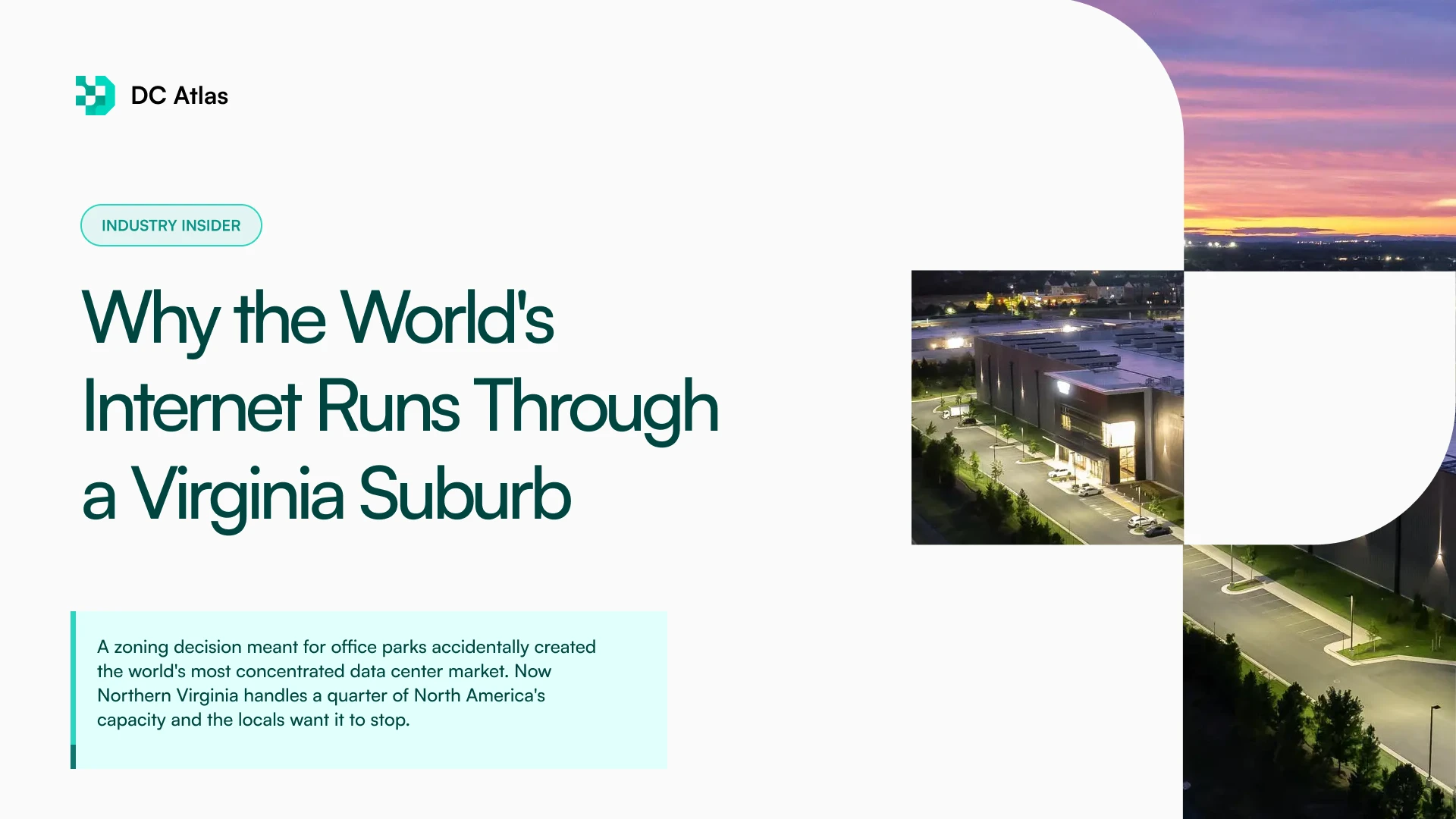
Ashburn Didn't Plan to Become the Center of the Internet. Now It Can't Stop.
A zoning decision meant for office parks accidentally created the world's most concentrated data center market. Now Northern Virginia handles a quarter of North America's capacity and the locals want it to stop.

Everyone talks about Northern Virginia like it was some grand master plan. Silicon Valley with better lobbyists, AWS with government contracts, the inevitable result of being near Washington DC. That's not how it happened. The truth is messier, more accidental, and involves a lot more farmers wondering what the hell just happened to their quiet corner of Virginia.
We're looking at a market with more than double the data center capacity of any other US market. A place where a single DNS configuration error can take down Netflix, Starbucks, and half the internet for nine hours. Where hundreds of data centers sit on 30 square miles of what used to be horse farms, burning through 5.3 gigawatts of power and growing fast enough to make utility executives wake up in cold sweats.
But here's what the analyst reports don't tell you: this all started because some network engineers got together over beer in 1992 and decided to connect their networks. And it's continuing because a county zoning administrator made a decision in 2000 that treated data centers like office buildings. Twenty five years later, the locals are begging their politicians to make it stop. The numbers show why this market matters. We're tracking 7.4 GW of operational capacity across hundreds of facilities, with another 3.9 GW under construction. But the real story isn't in our database. It's in the sequence of accidents, shortcuts, and unintended consequences that turned Loudoun County farmland into the backbone of the global internet.
The Founding Myth Everyone Gets Wrong
You've heard the narrative: government contractors, defense spending, proximity to power. It sounds logical. It's also backwards. The real story starts with Metropolitan Area Exchange East, created in 1992 when a group of network providers in the Virginia area got together over beer one night and decided to connect their networks.
MAE-East wasn't planned by DARPA or the NSF. It was the brainchild of Scott Yeager from Metropolitan Fiber Systems and Rick Adams from UUNET, who needed a place to connect three networks: AlterNet, PSINet, and Sprint ICM. They used shared 10 Mbps Ethernet over fiber optic links, which was cutting edge for 1992 but wouldn't run a modern smart doorbell today.
The location choice was prosaic: MFS had fiber infrastructure in Northern Virginia because they'd been serving business customers since 1988. When the National Science Foundation designated MAE-East as one of four original Network Access Points in 1993, it wasn't picking Northern Virginia as much as recognizing what was already happening there.
By 1997, an estimated half of the world's internet traffic passed through MAE-East, housed in a cinder block room carved out of the underground parking garage at 1919 Gallows Road in Vienna. We're talking about a facility smaller than most people's basements handling more internet traffic than entire continents see today.
The technical constraints were brutal. The original GigaSwitch equipment suffered from head of line blocking. Access was limited to 100 Mbps when everyone needed gigabit connections. Outages became frequent enough that major ISPs started demanding alternatives. When MAE-East finally shut down in 2009, most of the traffic had already migrated to newer facilities in Ashburn, just 15 miles west.
But here's what matters: by the time MAE-East reached its limits, the network effects were locked in. Fiber routes were built. Engineers had moved to the area. The ecosystem had critical mass. Moving the exchange point from Vienna to Ashburn didn't change the fundamental dynamics. It just shifted the concentration a few miles down Route 7.
The Fiber That Nobody Planned
The second accident was fiber infrastructure that nobody designed for data centers because data centers didn't exist yet. Northern Virginia's networking advantage started with ARPANET in the 1960s, which had significant presence around Arlington because of defense contractors and federal agencies. This created a base layer of technical expertise and fiber optic infrastructure near Washington DC.
Metropolitan Fiber Systems built on this foundation starting in 1988. By 1991, MFS owned fiber optic lines in 11 US cities and had become the largest independent competitor to regional Bell operating companies. They weren't building for the internet. They were serving large business customers who needed dedicated fiber connections for telephone, fax, and early data services.
When MFS acquired UUNET for $2 billion in April 1996, and WorldCom then acquired MFS for $14 billion in December 1996, it created the first company that could offer end to end fiber optic connectivity for internet services. But the fiber routes had been laid years earlier for completely different purposes.
America Online's move to Loudoun County in 1996 accelerated the buildout. AOL needed massive bandwidth for dial up internet service and had grown out of their Tysons Corner facility. An AOL employee named Steve Gaitten drove to the new site and wept to once past Reston, all he could see were cedar trees and open farmland. AOL employed 5,300 people at peak in 2004, creating what Loudoun County Economic Development calls 4,000 employee millionaires before the dot com crash.
The fiber infrastructure that exists today in Data Center Alley wasn't planned for hyperscale data centers or cloud computing. It was built for telephone service, federal contractors, and dial up internet. The fact that it became the foundation for half the world's cloud infrastructure was pure accident. But once it existed, the economics of building more became overwhelming.
The $150 Million Tax Accident
The third piece fell into place in 2010, when Virginia created what may be the most successful economic development incentive in US history. Virginia Code Section 58.1 to 609.3 eliminates the 6% state sales tax on data center equipment for facilities that invest at least $150 million and create 50 jobs.
The exemption covers servers, routers, generators, chillers, backup equipment, and enabling software. For a typical hyperscale data center investing $500 million in equipment, that's $30 million in tax savings. For the largest facilities investing over $1 billion, it's real money that moves location decisions.
The Virginia Joint Legislative Audit and Review Commission determined in 2019 that 90% of the data center investment made by companies receiving the tax exemption would not have occurred in Virginia without the incentive. That's unusually high effectiveness for a tax incentive program. Most economic development credits show much lower impact ratios.
The exemption was originally scheduled to expire in 2020 but has been extended through 2035. As AI workloads drive server costs higher and rack densities from 10 to 14 kW to 40 to 120 kW, the value of the equipment exemption keeps growing. We're seeing planning discussions for facilities that could hit $2 to 3 billion in equipment costs, making the Virginia tax advantage worth $120 to 180 million per project.
Loudoun County's Data Center Tax Revenue Boom
Revenue has grown 348% since 2018, now covering nearly the entire county operating budget
Source: Loudoun County Budget Documents via Various Reports
But the state incentive was just the setup. The real accelerant was local property tax policy. Data centers pay personal property tax on their computer equipment at the same rate as office furniture and business vehicles. For a $500 million server farm, that generates $5 to 10 million per year in local tax revenue while requiring almost no county services. As one Loudoun County official put it: a data center costs the county $0.04 per $1 of tax revenue, compared to $0.25 for typical businesses.
Loudoun County collected $875 million in data center taxes in fiscal 2024. That's more than the county's entire general operations budget. Data centers occupy 4% of commercial parcels but generate 38% of general fund revenue. This windfall has let the county build 36 schools, invest $1 billion in roads, and maintain the lowest property tax rate in Northern Virginia.
The locals are getting paid to host the internet. The question is whether they think it's enough.
The Zoning Decision That Changed Everything
The fourth and most consequential accident happened in 2000, when a Loudoun County zoning administrator made a determination that would reshape the global internet. The question was simple: how should data centers be classified under the county's zoning ordinance? The answer was deceptively simple: treat them like office parks.
This made data center development "by right" on any office zoned land. No public hearings. No special permits. No Board of Supervisors approval. If your land was zoned for offices and you wanted to build a data center, you just needed to meet the standard setback and design requirements for office buildings. For 25 years, this was the regulatory framework governing the world's largest concentration of data center development.
The implications were enormous. A typical rezoning process for a major data center takes 12 to 18 months, involves multiple public hearings, and can be denied by local officials responding to community opposition. In Loudoun County, you could break ground on a 100 MW facility in 6 months if your paperwork was in order.
Loudoun County Data Center Growth Explosion
Permitted data center square footage has grown 434% since 2016
Source: Loudoun County Commissioner of Revenue via Supervisor Turner 2025 Report
The numbers tell the story. Permitted data center square footage in Loudoun County grew 434% from 8.8 million in 2016 to 47 million in 2025. There hasn't been a single day in the past 15 years when a data center wasn't under construction somewhere in the county. The development pipeline includes another 40 million square feet in applications under review.
This regulatory advantage attracted every major data center developer in the world. Equinix, Digital Realty, QTS, CloudHQ, Iron Mountain, Switch all have major footprints in Loudoun County. Amazon's US-East-1 region, Microsoft's East US region, and Google's us-east1 region are all anchored in Northern Virginia data centers that were built under the by right framework.
But nothing lasts forever. On March 18, 2025, the Loudoun County Board of Supervisors voted 7 to 2 to end by right data center development. Chair Phyllis Randall explained the decision: I have people say, 'I will pay more. Stop building these.' At some point, we just cannot ignore the voice of the people.
Twenty two projects were grandfathered under the old rules. Everything else now requires public hearings, Planning Commission review, and Board of Supervisors approval. The era of frictionless data center development in Loudoun County is over.
The Operators Who Built an Empire
The by right zoning framework created a land rush that attracted every major data center operator in the world. We're tracking 86 operators across hundreds of facilities in Northern Virginia, but the market is dominated by a handful of companies that understood the opportunity early and built at scale.
Amazon is the elephant in the room. AWS's US-East-1 region contains six availability zones, each requiring multiple data centers for redundancy, and we track Amazon as the market's largest operator with 2.3 GW of operational capacity across more than 80 facilities, plus another 420 MW under construction. That makes them possibly the largest single consumer of data center space in the world.
Among the developers, CloudHQ is the market's biggest builder: 542 MW operational across three sites, with another 1.7 GW under construction — including a single campus in the region drawing plans for more than 1.2 GW. Digital Realty operates 718 MW across 16 facilities, focusing on colocation and interconnection services. QTS has roughly 300 MW across six facilities, specializing in hyperscale wholesale deployments.
The development pipeline tells the story of continued dominance. We're tracking 3.9 GW under construction across the region, with CloudHQ, Digital Realty, and QTS all expanding existing campuses. Iron Mountain is building massive new facilities in Manassas. Switch has a 1.7 million square foot campus under development in Loudoun County.
But the most interesting dynamics are happening at the hyperscale level.
Northern Virginia Facility Size Breakdown
Facilities of 100 MW or more are 11% of sites but about 64% of verified capacity
Hyperscale facilities of 100 MW or more represent about 11% of facilities in Northern Virginia but account for roughly 64% of the region's verified capacity. These are the facilities that house AWS, Microsoft Azure, and Google Cloud infrastructure. They're also the facilities that consume the most power, generate the most tax revenue, and create the most community opposition.
The operators building these facilities understand that Northern Virginia's advantages compound over time. Every new facility built here makes the market more attractive for the next facility. Every fiber route laid makes connectivity better for everyone. Every power substation built increases grid capacity for all users. The network effects that started with MAE-East in 1992 are still growing stronger today.
When Success Becomes a Problem
Northern Virginia's Exploding Power Demand
Data center power consumption has increased 176% since 2019, with AI driving even higher demand
Source: PJM/Dominion Energy via JLARC 2024 Report
The fourth quarter of 2024 was when the cracks started showing. Power demand from data centers hit 5.33 GW, up from 1.5 GW just six years earlier. Dominion Energy reported 40 GW of contracted data center power capacity across Northern Virginia, an 88% increase in six months. PJM Interconnection, the regional grid operator, declared Data Center Alley a constrained zone in July 2022, limiting new power connections until new transmission lines come online around 2027.
The constraint isn't generation. Virginia has plenty of natural gas plants and is adding solar capacity rapidly. The constraint is transmission: getting power from generators to data centers requires high voltage lines that take years to permit and build. The existing transmission infrastructure can handle about 9.3 GW entering Loudoun County. Planned upgrades will add roughly 6.3 GW by 2028, bringing total capacity to about 15.6 GW.
But demand projections show 11 to 12 GW by 2028 under conservative scenarios. With AI driving rack densities from 10 to 14 kW to 40 to 120 kW, some projections show demand reaching 20 to 30 GW by 2029. The infrastructure can't keep up.
This creates a cascading series of problems. Developers are buying land years before they can get power connections. Utilities are struggling to finance transmission upgrades that cost billions and take half a decade to complete. Communities are dealing with constant construction, truck traffic, and industrial development in areas that were residential or agricultural just a decade ago.
The community pushback has been building for years but reached a tipping point in 2023 and 2024. Residents began organizing against proposed transmission lines. The Loudoun County Board of Supervisors started denying applications for the first time. Prince William County approved a controversial 27.6 million square foot data center complex adjacent to Manassas National Battlefield Park, only to have it overturned by a circuit court judge who ruled the approval process was inadequate.
The March 2025 decision to end by right data center development in Loudoun County was the clearest signal yet that the era of unlimited growth is ending. But with 22 projects grandfathered under the old rules and massive development pipelines in neighboring jurisdictions, the growth will continue for years to come.
The Concentration Risk Nobody Talks About
Global Data Center Market Leaders
Northern Virginia dominates global capacity with more than double second-place Beijing
Source: Cushman & Wakefield 2024 Global Data Center Market Comparison
The success of Northern Virginia has created a concentration of internet infrastructure that would have been unimaginable when MAE-East was handling half the world's traffic from a parking garage in Vienna. Counting everything we track across all development stages — 7.4 GW operational plus a 4.3 GW pipeline — Northern Virginia now represents roughly 16% of North American data center capacity and about 9% of global capacity. On Cushman & Wakefield's operational market comparison above, it's more than double the size of Beijing, the second largest market globally.
Northern Virginia vs Major US Markets: Capacity and Pipeline
Northern Virginia's operational base and development pipeline dwarf every other major US market
Current verified capacity and development pipeline; a dated year-by-year growth series is not yet published for these markets. Pipeline includes modeled estimates where a verified MW is not yet published.
This concentration creates systemic risks that are just starting to be understood. On October 20, 2025, a DNS resolution failure in AWS's US-East-1 region in Ashburn cascaded through DynamoDB, IAM, EC2, and dozens of other services for approximately nine hours. Over 2,500 organizations were disrupted, including Netflix, Starbucks, Venmo, Coinbase, McDonald's mobile ordering, and Fortnite.
The geographic concentration meant that a single technical failure in Ashburn rippled across the global internet. Even organizations without direct AWS contracts experienced downtime because their SaaS vendors, payment processors, and authentication services depended on US-East-1.
This wasn't the first time. AWS's US-East-1 region has experienced major outages in December 2021, September 2021, and February 2017. Each time, the impact extended far beyond Amazon's direct customers because of the region's role as a critical dependency for internet infrastructure globally.
The concentration extends beyond AWS. Microsoft's East US region, Google's us-east1 region, and dozens of other cloud platforms are anchored in Northern Virginia data centers. A major power outage, natural disaster, or infrastructure failure affecting Data Center Alley could potentially disrupt a significant portion of global internet services.
Yet the market keeps growing. The economic incentives are too powerful, the network effects too entrenched, and the infrastructure advantages too significant for growth to slow materially. Every major cloud provider needs capacity in Northern Virginia to serve East Coast customers with low latency. Every enterprise needs connectivity to Northern Virginia to access cloud services efficiently. We're tracking 3.9 GW under construction across Northern Virginia, representing about 52% growth over current operational capacity. The planning pipeline is even larger, with applications for facilities that could add another 3 to 4 GW over the next five years. Unless something dramatic changes, Northern Virginia's dominance of global data center capacity will continue to grow.
What Happens When You Can't Stop
The story of Northern Virginia is the story of accumulated advantages that become impossible to reverse. Fiber infrastructure that was built for telephone service became the foundation for internet exchanges. Tax incentives designed to attract a few facilities created a development boom. Zoning rules meant for office parks enabled industrial development at unprecedented scale. Network effects that started with MAE-East continue to attract new investment thirty years later.
“At some point, we just cannot ignore the voice of the people.”
The March 2025 decision to end by right data center development signals that the political consensus supporting unlimited growth is breaking down. But the economic logic remains overwhelming. Northern Virginia generates nearly $900 million per year in local tax revenue from data centers. The Virginia state economy receives billions in capital investment and thousands of high paying jobs. The global internet depends on infrastructure that's increasingly concentrated in a 30 square mile area of Loudoun County.
None of this was planned. MAE-East was network engineers solving a connectivity problem over beer. The fiber infrastructure was built for telephone service and federal contractors. The tax incentives were economic development policy. The zoning decision was an administrative determination about how to classify a new type of facility. AOL moved to Loudoun County because they needed space and the land was cheap.
But accidental advantages, once established, become self reinforcing. Every data center built in Northern Virginia makes the market more attractive for the next data center. Every fiber route laid improves connectivity for all users. Every power substation built increases capacity for all facilities. The cluster effects that created Silicon Valley's dominance in technology are playing out in Northern Virginia's dominance of internet infrastructure.
The question now is whether physical and political constraints can slow growth that economic logic says should continue indefinitely. Power transmission limits will constrain development for several years starting in 2027. Community opposition will make permitting more difficult and expensive. Zoning changes will slow approvals and reduce certainty for developers.
But the fundamental drivers remain intact. Virginia's tax incentives run through 2035. Fiber infrastructure advantages will persist for decades. AWS, Microsoft, Google, and other major cloud providers will continue needing massive amounts of capacity in Northern Virginia to serve East Coast customers with low latency. The network effects that started with MAE-East in 1992 show no signs of weakening.
Ashburn didn't plan to become the center of the internet. It happened through a series of accidents, shortcuts, and unintended consequences that accumulated over three decades. Now it can't stop, even when the locals are begging their politicians to make it stop. The economic logic is too powerful, the infrastructure advantages too entrenched, and the global dependencies too deep.
That's how you accidentally build the most important 30 square miles in the global internet. And why it's probably going to keep growing whether anyone wants it to or not.